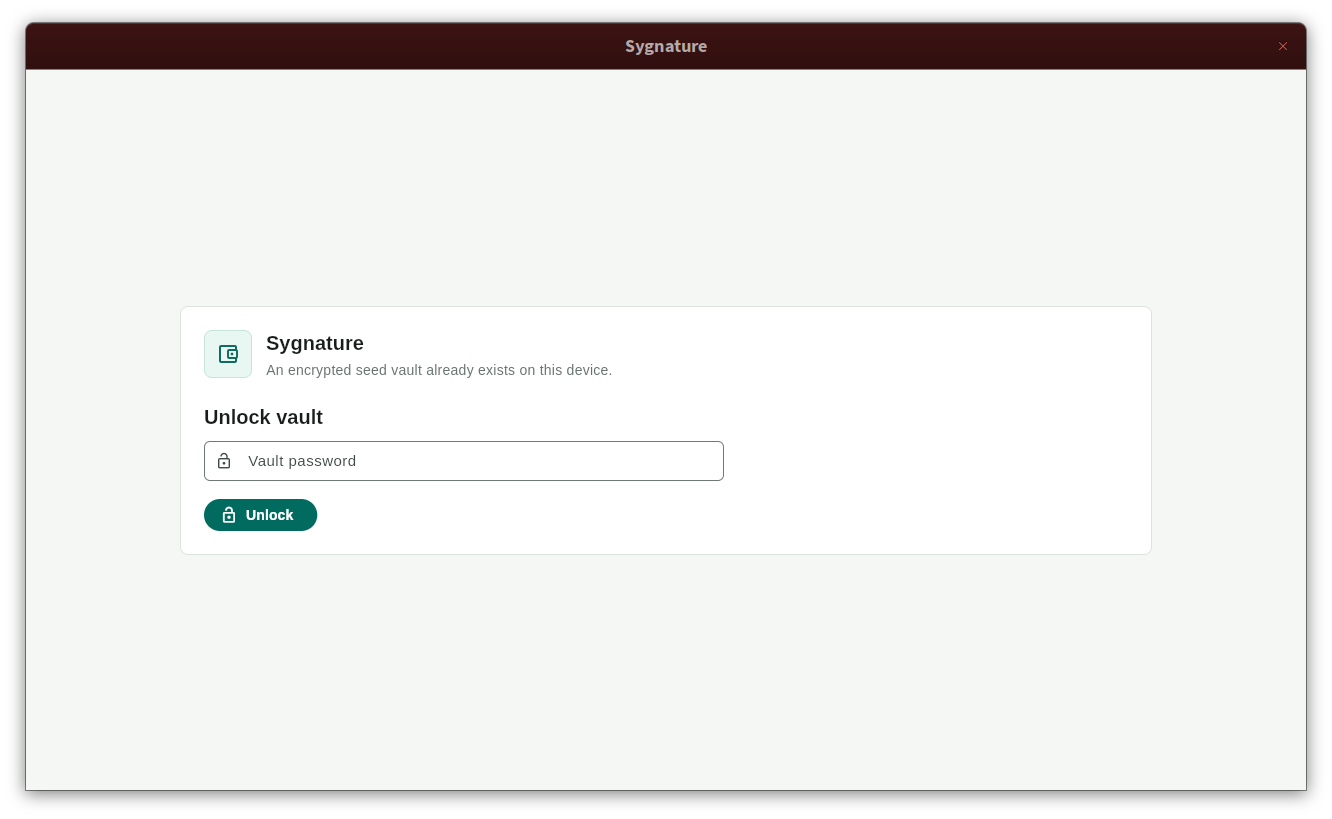
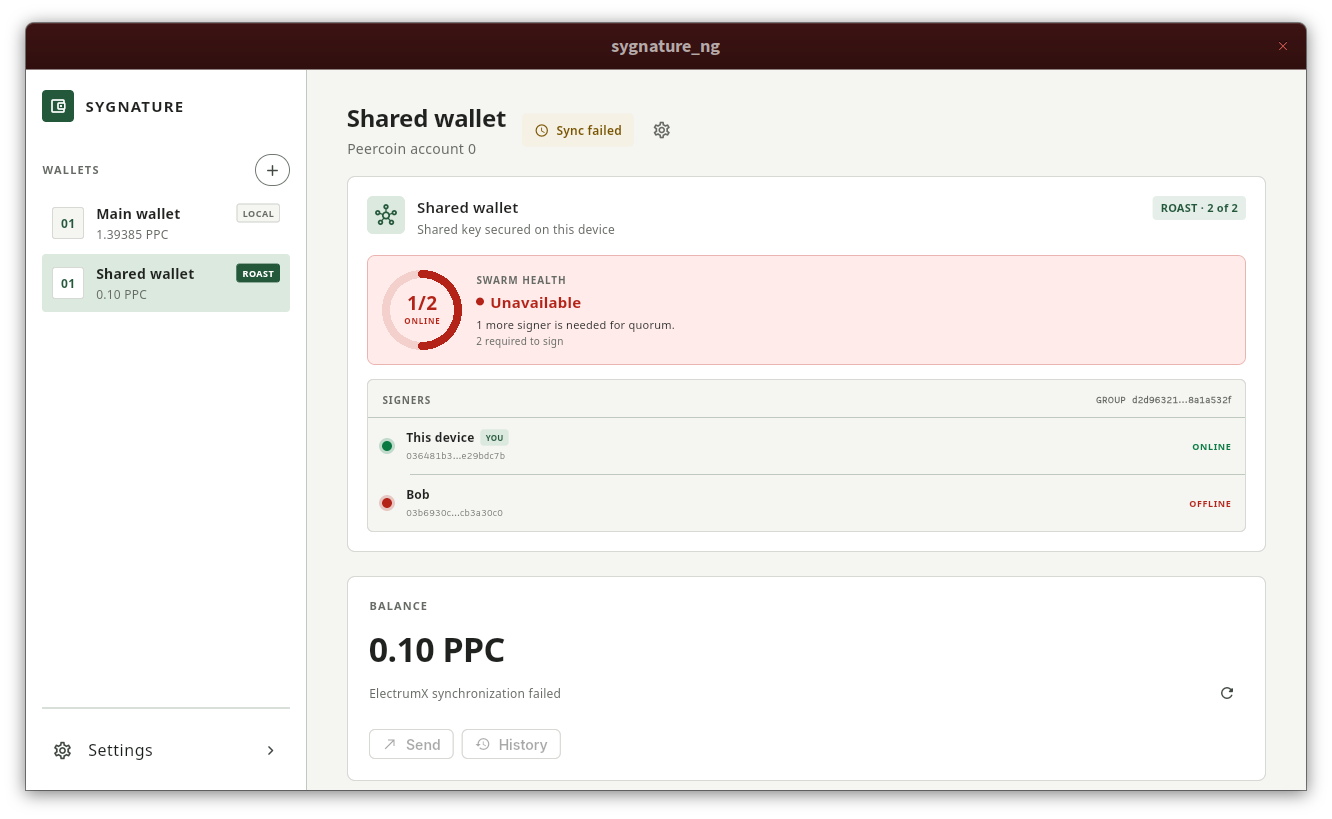
Sygnature is a wallet project focused on threshold signing (ROAST).
Instead of keeping one private key on one machine, it lets a group of participants create and use a shared ROAST/FROST signing key. The goal is to make multisigs of massive scale feel closer to a normal wallet workflow.
The wallet has a coordinator-based ROAST flow. Participants import or create client configs, connect to the coordinator, run DKG to generate a shared group public key, and then use that key to derive the wallet address. Each participant keeps their own secret share locally, and signing requires the configured threshold of participants to cooperate.
It also supports normal, single-signature wallets.
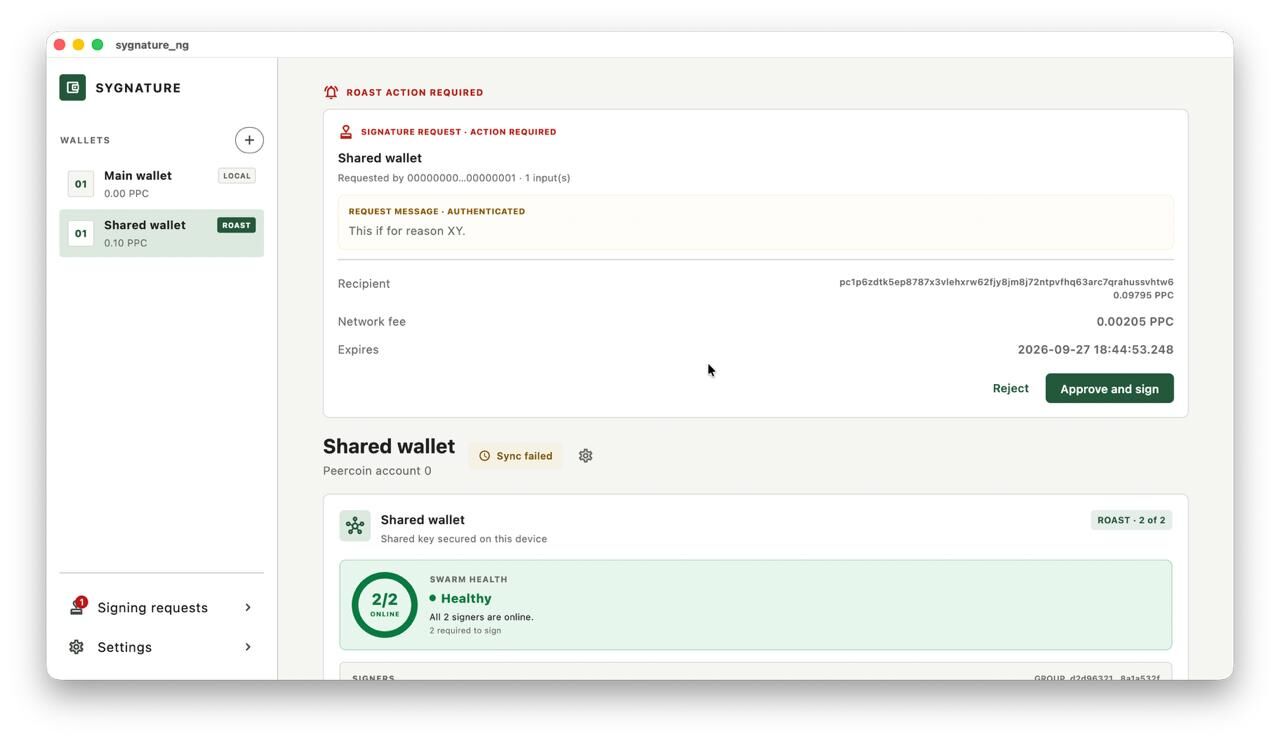
For transactions, Sygnature builds a proposal that can be reviewed by peers before signing. The proposal shows the destination, amount, selected inputs, outputs including change, fee, unsigned transaction hex, Taproot signing details, message hashes, group key, creator, and expiry. Once enough participants approve and contribute signing shares, the client assembles the final Schnorr signature and broadcasts the transaction to the network.
The current work has been heavily focused on making the web and desktop clients reliable with the ROAST coordinator. I tested the app on Linux, Web, and OSX. It works well but there are still some bugs and UX is rough around the edges. I will publish the source code and host the web app soon ™.
Project is in active developement, but the direction is a practical threshold wallet for Peercoin that keeps the user-facing flow understandable while using the FROST/ROAST signing underneath.
________________________
Future prospects
I want to implement this “room” model for ROAST coordination. A user would create a room, become its admin, and invite other participants through a signed room descriptor and invite link. Links would look like this: app://join-room?room_id=room_123&server=wss://signal.example.com
The admin’s client app could act as the default ROAST coordinator, with WebRTC used for peer to peer communication. This design would avoid relying on a server which would host the ROAST coordinator.
Each room could contain ROAST wallets across multiple networks, such as Peercoin, Bitcoin, Litecoin, and other UTXO chains which support Schnorr signatures. It could also support Ethereum-style smart-contract accounts. The broader idea is something like a shared wallet for assets such as USDC, but using ROAST threshold signing. This builds on the cross-chain transaction experiments I demonstrated last year in my `coinlibplayground2` repo.
At this point this is very close to my idea of a “Network Wallet”. Then it will be time to think about seamless cross-chain swaps without the need to wrap coins, oracles, DLC marketplace, the lot. 
___________________________________
Some screenshots: